

Online education has become an important part of modern learning. Students can now attend virtual classes, watch educational videos, access digital books, and learn new skills from home. However, online learning also comes with challenges. Some students struggle to understand difficult topics, manage their study time, stay motivated, or prepare for exams without direct support from a teacher.
In my opinion, new AI tools are making online education more convenient, flexible, and personalized. Artificial intelligence can help students understand lessons, improve their writing, organize their notes, and practice important concepts. When used correctly, AI tools can become helpful learning partners for students of different ages and educational backgrounds.
The best part is that many AI learning tools are easy to use and offer free features. Students do not always need expensive software to improve their learning experience. They can begin with simple tools that support their existing study habits and gradually discover more advanced features.
In this article, I will explain how new AI tools can help students learn online, improve their academic performance, and develop useful skills for the future.
What Are AI Tools for Online Learning?
AI tools for online learning are digital applications that use artificial intelligence to help students study more effectively. These tools can answer questions, explain complex subjects, summarize information, generate practice quizzes, and provide feedback on written assignments.
Unlike traditional educational software, many modern AI tools can respond to individual questions and adjust their explanations according to a student’s needs.
For example, if a student finds a mathematics problem difficult, an AI assistant can explain the steps involved in solving it. If another student wants to improve English grammar, an AI writing assistant can identify errors and suggest corrections.
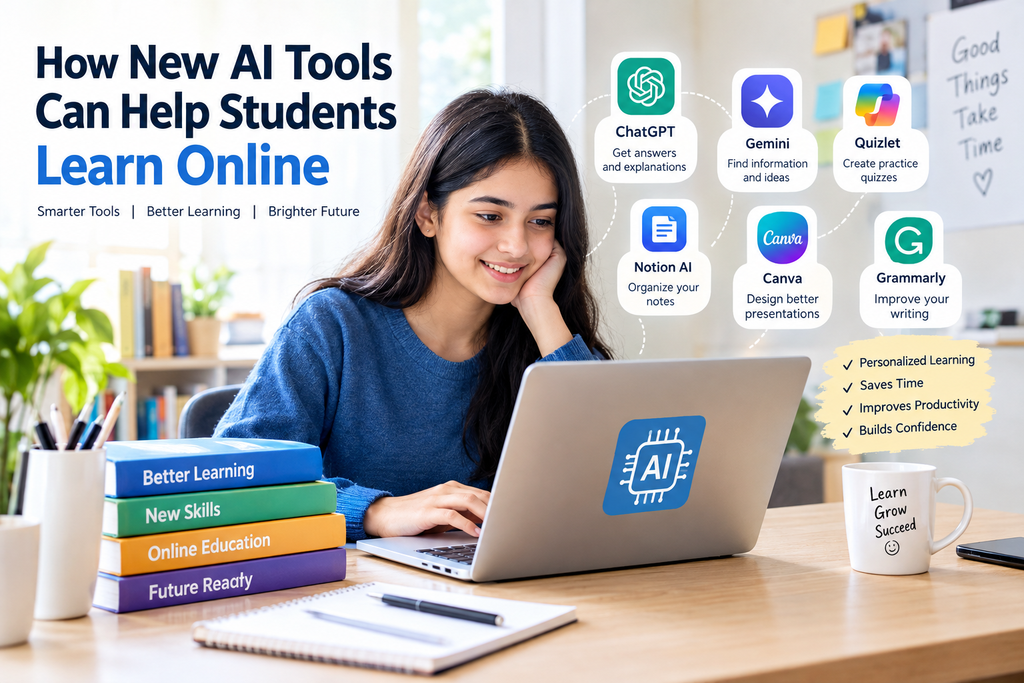
Popular options include ChatGPT, Google Gemini, Grammarly, Quizlet, and other educational platforms with AI powered features. Each tool offers different functions, so students should select the ones that match their learning goals.
1. Personalized Learning for Every Student
One of the biggest benefits of artificial intelligence in education is personalized learning. Every student has a different learning speed, level of understanding, and preferred study method. A lesson that seems simple to one student may be confusing to another.
AI learning tools can help students receive explanations that match their current level of knowledge. They can ask an AI assistant to explain a topic in simple English, provide additional examples, or divide a complicated lesson into smaller sections.
For example, a student studying science may understand a definition but struggle to understand how it works in real life. An AI tool can provide everyday examples to make the concept easier to understand.
In my view, this flexibility is especially useful for students who feel uncomfortable asking questions in a traditional classroom. They can review a topic as many times as needed without feeling embarrassed.
Personalized learning does not replace the role of teachers. Instead, it gives students another way to practice, review, and understand their lessons.
2. Understanding Difficult Subjects More Easily
Some subjects require additional explanation and regular practice. Mathematics, physics, chemistry, computer science, and grammar are common examples.
New AI tools can help students break difficult subjects into manageable steps. Instead of simply receiving a short answer, students can ask for a detailed explanation of the process.
For instance, a student learning algebra can request a step by step explanation of an equation. A computer science student can ask for help understanding a programming concept. A history student can request a simple summary of an important event.
AI assistants can also generate examples and follow up with practice questions. This allows students to test their understanding immediately after studying a topic.
However, AI systems can sometimes provide incorrect information or make mistakes in calculations. Students should compare important answers with textbooks, class notes, and trusted educational sources.
The main goal should be understanding the subject rather than copying an answer without learning anything from it.
3. Improving Writing and Grammar Skills
Writing is an essential skill for students who study online. They regularly prepare assignments, discussion posts, reports, presentations, and emails to teachers.
AI writing tools can help students improve sentence structure, spelling, punctuation, and grammar. Tools such as Grammarly can identify certain writing problems and suggest ways to make sentences clearer.
Students can also use AI assistants to understand why a sentence is incorrect or how to organize their ideas more effectively.
For example, a student writing an essay about environmental protection can request feedback on the introduction, paragraph structure, and clarity of the conclusion.
I believe students should use these tools as learning assistants instead of allowing them to complete every assignment. Writing the first draft independently and then reviewing suggestions can help students develop stronger communication skills.
Students must also follow their school’s academic integrity rules and disclose AI assistance when required.
4. Saving Time Through Smart Study Planning
Managing time is one of the biggest challenges of online education. Students often balance classes, homework, examinations, family responsibilities, and personal activities.
AI productivity tools can help students organize these responsibilities into a practical study schedule. Students can provide their subjects, examination dates, available study hours, and priorities to generate a suggested timetable.
For example, a student preparing for three examinations in one week can divide revision into smaller daily sessions. The plan might include mathematics practice in the morning, science revision in the afternoon, and a short review of previous lessons in the evening.
AI tools can also help create checklists, summarize study materials, and organize important tasks.
In my opinion, a realistic schedule is more useful than a complicated plan that students cannot follow. AI can suggest a starting point, but students should adjust the timetable according to their energy, deadlines, and actual progress.
5. Creating Practice Quizzes and Flashcards
Regular practice helps students remember information and identify weaknesses. Reading the same chapter repeatedly may not always reveal whether a student truly understands the material.
AI powered educational tools can turn notes into practice questions, flashcards, and short quizzes. Some platforms, including Quizlet, provide study features that help learners review information and test their knowledge.
Suppose a student has completed a chapter about human biology. They can use an appropriate AI tool to create ten multiple choice questions based on their notes. After answering the questions, they can review the topics they found difficult.
Flashcards are particularly useful for learning vocabulary, scientific terms, historical dates, and definitions.
I recommend combining these tools with active recall, which means trying to remember information before looking at the answer. This approach encourages students to participate actively instead of simply reading the same material again.
6. Making Online Research Easier
Online research is an important part of school, college, and university education. Students often need to collect information from several sources before writing an assignment or preparing a presentation.
AI tools can help students identify relevant topics, generate research questions, explain unfamiliar terminology, and organize their initial ideas.
For example, a student researching renewable energy can ask an AI assistant to suggest subtopics such as solar power, wind energy, environmental benefits, and installation costs.
This gives the student a starting point for more detailed research.
However, AI generated information should not automatically be treated as verified evidence. Some systems produce outdated facts, inaccurate references, or misleading explanations. Students should check original sources, use reliable publications, and confirm that any references actually exist.
Good research involves evaluating information rather than accepting the first answer provided by a digital tool.
7. Supporting Students Who Learn at Different Speeds
Not every student understands a lesson at the same speed. Some learners need additional practice, while others are ready to explore advanced concepts.
AI tools allow students to review information repeatedly and request alternative explanations whenever necessary. This can make online education more flexible.
Students learning English as an additional language may benefit from vocabulary explanations, grammar feedback, and simplified descriptions of unfamiliar terms. Learners who need larger amounts of practice can also generate additional exercises.
Certain educational technologies offer accessibility features such as speech to text, text to speech, captions, and text simplification. These features can make digital learning materials easier to access for students with different needs.
Nevertheless, accessibility requirements vary. Students who need specific accommodations should check whether a platform supports the features they require.
8. Improving Focus and Motivation
Studying at home can be difficult when mobile notifications, household activities, and entertainment compete for attention.
AI productivity applications can help students organize tasks, divide large assignments into smaller goals, and track their progress. Some educational platforms also offer recommendations based on completed activities or areas where a student needs more practice.
For example, instead of setting a vague goal such as studying mathematics all day, a student can set a smaller target to complete five equations and review two difficult concepts.
Small achievements can make a large workload feel more manageable.
In my view, motivation improves when students have clear goals and can see their progress. AI tools may help with planning, but healthy routines, sufficient sleep, regular breaks, and a comfortable study environment remain important.
Students should also avoid spending so much time experimenting with new applications that they have less time for actual learning.
9. Preparing Better Online Presentations
Presentations are a common requirement in online classes. Students may need to explain research findings, introduce a project, or share information with classmates.
AI powered presentation tools can help organize ideas, suggest slide structures, and create visual materials. Canva, for example, offers design features that can help users prepare presentations and other educational content.
Students can begin by writing their own main points and then use appropriate tools to improve the organization and appearance of their slides.
A good presentation should contain clear headings, readable text, relevant images, and accurate information. Adding too many graphics or lengthy paragraphs can make slides difficult to follow.
AI can simplify the design process, but students still need to understand their topic well enough to explain it in their own words.
10. Important Challenges of Using AI in Education
Although AI tools offer many benefits, students should understand their limitations before relying on them.
Accuracy of information: AI tools can generate incorrect answers. Important facts should be checked against reliable sources.
Academic honesty: Submitting AI generated work as entirely personal work may violate school or university rules. Students should understand and follow their institution’s policies.
Privacy and security: Students should avoid uploading passwords, private records, personal identification documents, or confidential school information to AI platforms.
Overdependence on technology: Using AI for every question can weaken independent thinking if students stop trying to solve problems themselves.
Cost and access: Some tools offer free features, while advanced functions require payment. Students should compare available options and avoid spending money unnecessarily.
I believe the most effective approach is to use AI when it adds genuine educational value. Students should remain responsible for their decisions, their work, and their learning progress.
11. How to Start Using AI Tools for Online Study
Students do not need to use many applications at once. Starting with a few useful tools is often more effective.
Here is a simple approach:
1. Identify your main learning goal, such as improving English, understanding mathematics, or preparing for examinations.
2. Choose one suitable AI assistant or educational platform that supports that goal.
3. Ask specific questions and request explanations instead of simply asking for final answers.
4. Use your textbooks and class notes to verify important information.
5. Create practice questions after completing each lesson.
6. Review your mistakes and spend more time on topics you find difficult.
7. Evaluate your progress each week and adjust your study routine when necessary.
Students should also review the privacy settings and terms of the applications they use. If a school provides approved educational tools, those options may be a suitable place to begin.
Conclusion
New AI tools are changing online education by making learning more personalized, flexible, and accessible. They can help students understand difficult subjects, improve writing, organize study schedules, create practice quizzes, conduct research, and prepare presentations.
From my point of view, the greatest advantage of artificial intelligence is that it gives students more opportunities to ask questions, review lessons, and practice at their own pace. These benefits can be particularly valuable when students study independently or need extra support outside classroom hours.
However, AI should support education rather than replace teachers, textbooks, critical thinking, or independent effort. Students must check information carefully, protect their privacy, and follow academic integrity rules.
The future of online learning will depend not only on how advanced AI technology becomes but also on how wisely students use it. By choosing suitable tools and maintaining consistent study habits, learners can make online education more productive and develop skills that will benefit them throughout their academic and professional lives.


