Introduction
Preparing documents for scholarship applications is one of the most important steps for students who want to continue their education without putting too much pressure on their families financially. Many students search for scholarships, check eligibility requirements, and fill out application forms, but they sometimes forget that their documents also play an important role in the application process.
In my opinion, the best way to prepare a successful scholarship application is to start early, organize every document properly, and carefully follow the instructions provided by the scholarship organization. Even a strong student can face unnecessary problems if important paperwork is missing, incorrect, or submitted in the wrong format.
Whether you are applying for a scholarship after matric, intermediate, graduation, or for higher education abroad, proper preparation can make the process easier. In this guide, I will explain how to prepare documents for scholarship applications, which papers students may need, and how to avoid common mistakes.
1. Read the Scholarship Requirements Carefully
Before collecting documents, I recommend reading the official scholarship announcement from beginning to end. Every scholarship program has its own eligibility criteria and documentation requirements. Some programs ask for academic transcripts and identification documents, while others may require recommendation letters, a personal statement, or proof of financial need.
Students should never assume that the requirements for one scholarship are the same as those for another.
First, check the application deadline, eligible qualifications, age restrictions if applicable, required documents, and submission method. Also determine whether documents must be uploaded online, submitted by email, or delivered in printed form.
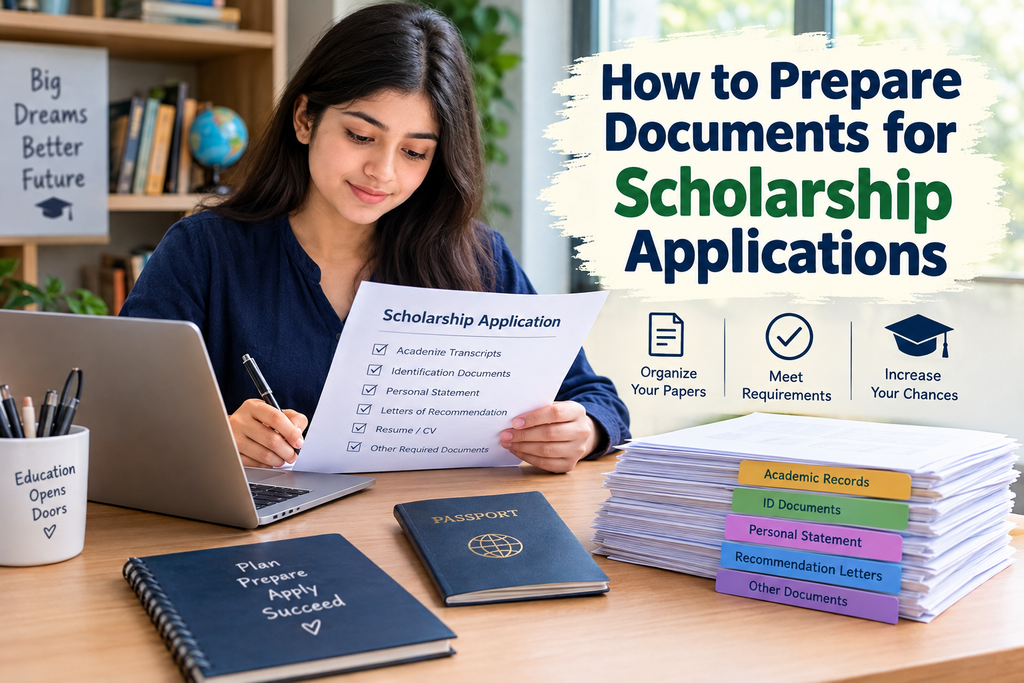
Create a checklist based on the official instructions. This simple step helps you identify missing documents early and reduces the risk of submitting an incomplete application.
2. Prepare Your Academic Certificates and Transcripts
Academic records are among the most common documents required for scholarship applications. They help scholarship committees understand your educational background and academic performance.
Depending on your current education level, you may need matriculation certificates, intermediate certificates, university transcripts, degree certificates, or result cards. Some scholarships accept provisional results, while others require official documents.
If you are applying for a scholarship after matric or intermediate, check whether your board certificate and marks sheet are sufficient. University applicants should confirm whether they need semester wise transcripts or a complete academic record.
Make clear digital scans of your original documents. Check that your name, marks, grades, registration number, and other important information are readable.
If your final certificate has not been issued yet, check whether the scholarship provider accepts a provisional certificate or an official result statement. Never submit an altered document or make changes to your academic marks.
3. Keep Your Identification Documents Ready
Identification documents help scholarship providers verify the applicant’s identity. Requirements vary by program and country, so students should check the official instructions before preparing their paperwork.
For students in Pakistan, commonly requested identification documents may include a CNIC, B Form, or passport, depending on the applicant’s age and the scholarship rules. International scholarships may require a valid passport, particularly when the selected student must travel abroad.
Check that your personal information is consistent across the application form and supporting documents. Differences in spelling, dates of birth, or names can create verification problems.
If your passport is expired and the scholarship requires a valid passport, investigate renewal requirements as early as possible. If you notice an error in an official document, contact the relevant issuing authority rather than trying to correct it yourself.
4. Write a Strong Personal Statement
A personal statement is an opportunity to explain your educational goals, interests, achievements, and reasons for applying. Not every scholarship requires one, but when it is requested, it can help the selection committee understand you beyond your academic results.
I believe a strong personal statement should be honest, clear, and connected to the purpose of the scholarship.
Start by explaining your educational background and the subject you want to study. Then discuss your interests, relevant experiences, future plans, and how the scholarship could help you achieve your goals.
For example, a student who wants to study computer science might explain an interest in technology, describe a relevant school project, and discuss plans to develop useful digital skills.
Avoid copying personal statements from the internet. Your experiences and ambitions are what make your application personal. Use simple, professional English, organize your ideas into paragraphs, and proofread the final version carefully.
Always follow the scholarship provider’s word limit and formatting instructions.
5. Request Recommendation Letters Early
Some scholarship programs require recommendation letters from teachers, lecturers, professors, employers, or other approved referees. These letters provide additional information about your academic performance, character, achievements, and potential.
If recommendation letters are required, contact your selected referees well before the deadline. Explain which scholarship you are applying for, why you need the letter, and when it must be submitted.
Provide your referee with useful information, such as your academic record, achievements, intended course, and career goals. This can help them write a relevant and accurate recommendation.
Do not write a letter pretending to be your teacher or referee. If the scholarship requires confidential recommendations or direct submission by the referee, follow that process exactly.
Before submitting your application, check whether the recommendation has been received and whether the scholarship provider requires a particular format.
6. Prepare a Resume or CV
A resume or curriculum vitae may be required for merit based scholarships, postgraduate programs, research opportunities, and international study applications.
Your CV should present your education, skills, achievements, relevant experience, volunteer activities, and extracurricular involvement in an organized way.
Students who have never worked in a formal job can still create a useful CV. School projects, academic competitions, student society participation, volunteer work, and relevant online courses may demonstrate valuable skills.
Keep the layout simple and professional. Use clear headings, consistent formatting, and readable fonts. Include only accurate information that you can explain if asked during an interview.
For most student scholarship applications, a concise CV is often easier to review than a lengthy document filled with unrelated information. However, always follow the scholarship’s specific instructions about CV length and content.
7. Collect Financial Documents When Required
Some scholarships consider the financial circumstances of applicants. These programs may ask for income certificates, salary slips, tax documents, bank statements, or other evidence of household finances.
The exact requirements depend on the scholarship provider. A need based scholarship may require different evidence from a merit based award.
If you are applying for financial assistance, read the instructions carefully and identify which family member’s financial information is required. Ask the relevant employer, institution, or issuing authority for official documents where necessary.
Make sure that any financial information you provide is accurate and up to date. Never create fake income certificates or change financial records to appear eligible.
If your family does not have a document listed in the requirements, contact the scholarship office to ask whether an alternative form of evidence is accepted. Do not assume that a substitute will be approved without confirmation.
8. Arrange English Language and Other Test Results
Some scholarships, especially those connected with international universities, require evidence of language proficiency or standardized test results.
Depending on the program, applicants may need an IELTS or TOEFL score, another accepted language test, or a relevant academic entrance examination result. Other scholarships may not require any language test at all.
Check whether the scholarship accepts your existing score and whether it remains valid for the required period. Also confirm whether the result must be sent directly by the testing organization.
If you have not taken a required test, plan ahead because registration, preparation, test dates, and result processing can take time.
Do not pay for a test unless it is actually required or useful for your intended application. Always consult the official scholarship and university requirements.
9. Scan and Organize Documents Properly
Once you have collected the required paperwork, organize it in a way that makes every file easy to find.
Create a main folder named Scholarship Applications. Inside it, create separate folders for academic records, identification, financial documents, recommendation letters, personal statements, and test results.
Save documents using clear filenames, such as:
- Matric Certificate
- Intermediate Transcript
- CNIC or Passport
- Personal Statement
- Recommendation Letter
- English Test Result
Use descriptive filenames that help you identify the document quickly. Avoid names such as Document1 or FinalFile2.
Scan documents clearly and make sure all pages are included. Remove unnecessary blank pages where permitted, but do not remove information that the scholarship committee needs.
If PDF files are requested, check that each file opens correctly and meets the stated file size limit. If photographs or JPG files are required, use the specified format instead.
Keep a secure backup of your documents so you can recover them if your computer or phone develops a problem. Since identification and financial documents contain private information, avoid sharing them through untrusted websites or public links.
10. Translate and Attest Documents When Necessary
Some scholarship providers require documents in a specific language. If your certificates are in Urdu or another language and the application requires English documents, you may need an accepted translation.
Check whether the scholarship organization requires a certified translation, notarization, attestation, or verification from an educational board or government authority.
Requirements differ between universities, scholarship programs, and countries. Do not spend money on unnecessary certification before confirming what is required.
If attestation is needed, allow enough time to complete the process. Keep copies of the original documents and their approved translations together so that you can provide both when requested.
11. Complete the Application Form Accurately
After preparing your documents, complete the scholarship application form carefully. The information in your form should match the information shown on your official records.
Check your full name, date of birth, contact details, educational history, grades, and identification numbers before submitting.
Enter a working email address and phone number because scholarship providers may contact you for verification or additional information.
If a question does not apply to you, follow the form’s instructions rather than entering random information. Review every required field and confirm that all requested files have been uploaded successfully.
If the application allows you to save a draft, use that feature to review your answers before final submission.
12. Avoid Common Scholarship Application Mistakes
Students can improve their preparation by avoiding a few common errors.
First, do not wait until the final day to collect documents. Some certificates and official letters take time to obtain.
Second, do not submit blurry scans, incomplete transcripts, or unreadable photographs. Poor document quality can make verification difficult.
Third, never provide false information, copied essays, or fabricated achievements. Scholarship committees may verify applications, and dishonesty can lead to rejection or other consequences.
Fourth, do not overlook small instructions about file formats, document size, signatures, or submission procedures.
Finally, avoid using the same personal statement for every scholarship without making relevant adjustments. Explain why you meet the requirements and how your goals relate to the particular opportunity.
13. Use a Final Scholarship Document Checklist
Before submitting your application, review the official requirements one more time. Depending on the scholarship, your checklist may include:
- Completed scholarship application form
- Academic certificates and transcripts
- CNIC, B Form, or passport when required
- Personal statement or scholarship essay
- Recommendation letters
- Resume or CV
- Financial evidence when required
- Language test or entrance test results when required
- Recent photograph if requested
- Certified translations or attestations when required
This list is a general guide, not a universal requirement. Only submit documents requested or accepted by the scholarship provider.
Check the application deadline and save proof of submission, such as a confirmation email or application reference number, if one is provided.
Conclusion
Preparing documents for scholarship applications becomes much easier when students plan ahead and follow a clear process. From academic certificates and identification papers to personal statements and recommendation letters, every required document should be accurate, readable, and submitted in the correct format.
In my view, the most important habits are starting early, reading official instructions, keeping documents organized, and checking every detail before submission. These steps cannot guarantee a scholarship, because selection depends on eligibility, competition, and the provider’s criteria. However, they can help you avoid preventable mistakes and present your application professionally.
If you are planning to apply for scholarships in Pakistan or abroad, begin by choosing a suitable scholarship and preparing a document checklist today. A little organization now can save time, reduce stress, and help you focus on your educational goals.