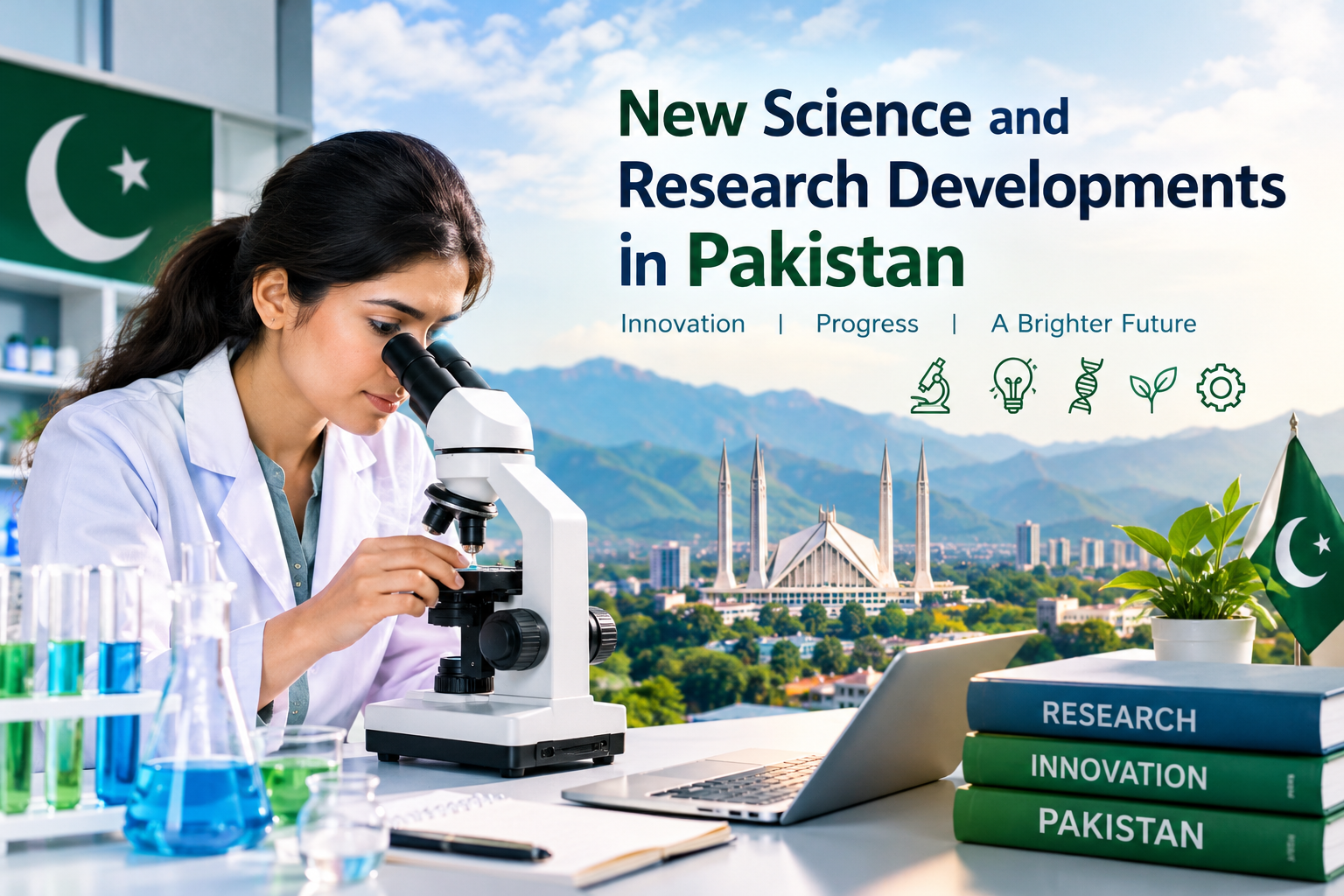
Science and research are becoming increasingly important for the future of Pakistan. In my view, a country cannot make long term progress without investing in knowledge, education, technology, and scientific research. Pakistan has many talented students, researchers, engineers, doctors, and scientists who are working in different fields to solve local and global problems.
Over the past few years, new science and research developments in Pakistan have appeared in areas such as artificial intelligence, agriculture, biotechnology, medicine, renewable energy, information technology, space research, and environmental science. These developments show that Pakistan has the potential to become a stronger participant in the global scientific community.
In this article, I will discuss some important areas of science and research in Pakistan and explain why these developments matter for the country’s future.
Growing Importance of Scientific Research in Pakistan
Scientific research helps a country understand its problems and find practical solutions. Pakistan faces challenges related to population growth, climate change, food security, water shortages, healthcare, energy, and education. Research can help develop better ways to deal with these issues.
Universities and research institutions across Pakistan are playing an important role in producing new knowledge. Students are also becoming more interested in research because technology has made information and learning resources easier to access.
I believe one of the biggest changes is that Pakistani students now have more opportunities to connect with international research communities. Online journals, digital libraries, research databases, online courses, and international conferences have made scientific knowledge more accessible.
Artificial Intelligence and Computer Science
Artificial intelligence is one of the fastest growing areas of science and technology around the world, and Pakistan is also becoming more interested in this field.
Researchers and students are working on machine learning, natural language processing, computer vision, data science, and intelligent software systems. Artificial intelligence can be useful in many areas of Pakistan, including healthcare, education, agriculture, banking, transportation, and business.
For example, AI systems can help analyze large amounts of information much faster than traditional methods. In healthcare, technology can support doctors by helping analyze medical images and patient information. In agriculture, intelligent systems can help farmers understand weather patterns, crop conditions, and possible plant diseases.
From my point of view, artificial intelligence can create many opportunities for young people in Pakistan because it does not always require expensive physical infrastructure. A student with a computer and internet connection can start learning programming, data science, or AI from home.
Developments in Medical Research
Medical research is another important area of scientific development in Pakistan. Researchers are working on diseases, public health, medical technology, genetics, pharmaceuticals, and diagnostic methods.
Pakistan has a large population and faces many healthcare challenges. Research can help improve diagnosis, treatment, disease prevention, and healthcare management.
Universities and medical institutions are also conducting studies related to infectious diseases, nutrition, maternal health, child health, and other public health concerns.
I think medical research is especially important because scientific discoveries can directly affect people’s quality of life. Better research can help doctors make informed decisions and can support the development of more effective healthcare services.
Agricultural Science and Food Research
Agriculture is a major part of Pakistan’s economy, which makes agricultural research extremely important. Scientists are researching better crops, soil health, irrigation methods, pest management, and climate resistant farming practices.
Climate change has created additional challenges for farmers. Changes in temperature, rainfall, drought conditions, and water availability can affect agricultural production.
Modern agricultural research can help farmers use resources more efficiently. Technology can also provide useful information about soil conditions and crop health.
In my opinion, Pakistan needs more research that connects scientific knowledge with the everyday needs of farmers. Research should not remain limited to laboratories. Useful discoveries should reach agricultural communities and help improve productivity and income.
Biotechnology and Genetic Research
Biotechnology is another field that has significant potential in Pakistan. It combines biology with technology to develop useful products, processes, and solutions.
Researchers are exploring biotechnology in agriculture, medicine, food science, environmental studies, and industrial applications.
Genetic research can also help scientists understand diseases and improve agricultural crops. Modern biological techniques can support the development of improved crops and help researchers study microorganisms and biological processes.
This field requires skilled researchers, modern laboratories, funding, and strong educational programs. If Pakistan continues to develop these areas, biotechnology could become an important part of the country’s scientific and economic future.
Renewable Energy Research
Energy is one of the major challenges for developing countries. Pakistan has significant potential for solar, wind, hydropower, and other renewable energy sources.
Researchers and engineers are working on ways to improve energy generation, storage, efficiency, and distribution.
Solar energy is particularly interesting because many parts of Pakistan receive strong sunlight during much of the year. Research can help make solar technology more affordable and efficient for homes, businesses, schools, and industries.
I believe renewable energy research can provide two benefits at the same time. It can support energy security while also helping reduce environmental pollution.
Climate and Environmental Research
Environmental research has become increasingly important because Pakistan is vulnerable to climate related problems. Floods, heat waves, water shortages, changing rainfall patterns, and other environmental challenges can affect millions of people.
Scientists are studying climate patterns, water resources, air pollution, biodiversity, glaciers, forests, and other environmental issues.
Environmental research can help policymakers make better decisions. For example, scientific data can help communities prepare for natural disasters and improve water management.
In my view, Pakistan needs more practical environmental research that focuses on local conditions. Solutions developed for other countries may not always work perfectly in Pakistan because climate, geography, population, and economic conditions are different.
Space and Satellite Research
Pakistan has also shown interest in space science and satellite technology. Space research has practical applications beyond astronomy.
Satellites can support communication, weather monitoring, agriculture, mapping, disaster management, environmental monitoring, and national development.
Satellite data can help researchers observe changes in land, forests, water resources, and agricultural areas. It can also provide useful information during floods and other natural disasters.
For students interested in science, space research can be an exciting field because it combines physics, mathematics, computer science, engineering, and data analysis.
Research in Information Technology
Information technology has created new opportunities for Pakistani researchers. Software development, cybersecurity, cloud computing, data science, mobile applications, and digital communication are all growing areas.
Pakistan has a large young population, and many students are learning computer skills through universities and online platforms.
Research in information technology can also help improve government services, education systems, financial services, and businesses.
I believe Pakistan has a strong opportunity in this area because software research does not always require the same level of physical resources as some laboratory based sciences. With proper training and access to modern computing facilities, Pakistani students can participate in international research projects.
Role of Pakistani Universities
Universities are at the center of scientific research. They provide students with opportunities to study advanced subjects, conduct experiments, publish research papers, and work with experienced researchers.
The quality of research can improve when universities have modern laboratories, updated equipment, research funding, experienced faculty, and connections with international institutions.
Students also need to develop research skills. Learning how to identify a research problem, collect reliable information, analyze data, and present findings is important for successful research.
In my opinion, universities should encourage students to focus more on solving real problems instead of only completing assignments for grades.

Challenges Facing Scientific Research
Although Pakistan has talented researchers, several challenges still affect scientific progress. Limited research funding, outdated laboratory equipment, fewer research opportunities, and difficulties in accessing advanced resources can slow progress.
Another challenge is the connection between research institutions and industries. Research becomes more valuable when scientific discoveries can be transformed into practical products and services.
There is also a need for stronger support for young researchers. Students with good ideas should have access to scholarships, laboratories, mentorship, and opportunities to present their work.
Future of Science and Research in Pakistan
The future of science and research in Pakistan can be promising if the country continues to invest in education, technology, and innovation.
Young people can play an important role in this future. Pakistani students can learn programming, data analysis, scientific writing, laboratory techniques, and other research skills. Online education has also created new opportunities for students who may not have access to every resource locally.
Pakistan can also benefit from international research collaboration. Working with researchers from other countries can provide access to new knowledge, equipment, methods, and ideas.
Final Thoughts
New science and research developments in Pakistan show that there is significant talent and potential within the country. From artificial intelligence and medical research to agriculture, biotechnology, renewable energy, environmental science, space technology, and information technology, many fields are creating new opportunities.
In my opinion, scientific progress should focus on solving real problems faced by ordinary people. Research should help improve healthcare, education, agriculture, energy, employment, and the environment.
Pakistan has a large population of young and talented people. If these people receive quality education, research opportunities, modern facilities, and proper support, they can contribute greatly to the country’s future.
Science is not only about laboratories and research papers. It is also about finding better answers to everyday problems. With continuous investment in knowledge and innovation, Pakistan can build a stronger research culture and become a more active contributor to global science and technology.